

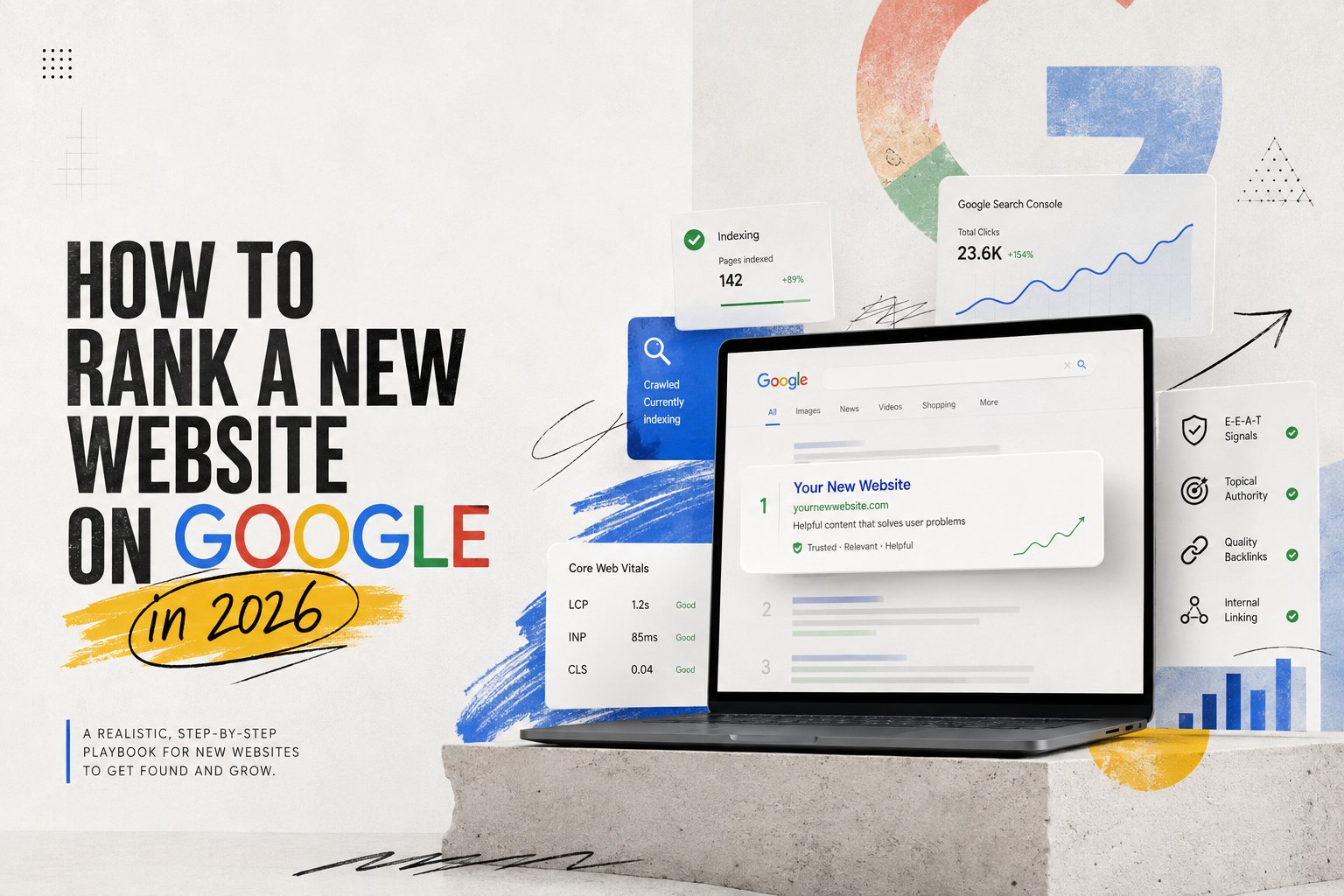
Launching a new website is the easy part. Getting Google to trust it is the part that actually determines whether the work you’re about to do pays off.
Quick Answer
Ranking a new website on Google is less about tricks and more about sequencing: get the site technically crawlable and indexable first, publish genuinely useful content built around real search intent, earn early signals of trust through links and mentions, and give Google time to observe consistent quality before expecting meaningful traffic. Most new websites see some visibility within the first few weeks for low-competition terms, but competitive rankings typically take three to twelve months, depending on niche difficulty, content quality, and how aggressively you build authority signals. There’s no shortcut that replaces this trust-building period — but there are ways to avoid wasting it.
Key Takeaways
- New websites don’t rank slowly because Google is punishing them — they rank slowly because trust has to be demonstrated over time, not declared on day one.
- Indexing and ranking are two different problems. Getting a page indexed is a technical prerequisite; getting it to rank is a quality and relevance problem.
- A submitted sitemap and a clean crawl are non-negotiable first steps, but they don’t guarantee visibility on their own.
- Depth on a narrow topic beats breadth across many topics for a new site trying to earn authority.
- Backlinks and mentions still matter, especially for competitive or YMYL (Your Money or Your Life) niches, but quality and relevance outweigh volume.
- Expect meaningful traffic in month three to six for low-to-medium competition terms, and six to twelve-plus months for competitive ones.
- Different Google surfaces — traditional search, AI Overviews, News, Discover — can behave very differently for the same new site, sometimes activating weeks apart from each other.
Why New Websites Don’t Rank Immediately
Here’s the honest starting point: Google has repeatedly said there’s no blanket policy that suppresses new sites simply for being new. But that statement, while technically accurate, misses the practical reality that almost every experienced SEO has lived through. New domains consistently go through a period where visibility feels artificially constrained, even when the content is solid and the technical setup is clean.
The more useful way to think about it isn’t “Google punishes new sites.” It’s that ranking is fundamentally a trust exercise, and trust can’t be established instantly. When a domain is brand-new, Google has no history to evaluate. It doesn’t know if your site will still exist in six months. It doesn’t know if your content is accurate, if your “About” page is honest, or if your published claims hold up. It only knows what it can observe — and observation takes time.
Compare this to how you’d evaluate a new coworker versus one who’s been on your team for three years. You don’t distrust the new person; you simply don’t yet have enough data points to fully rely on their judgment on a high-stakes decision. Google’s ranking systems behave similarly. Established sites have years of engagement data, backlink accumulation, content consistency, and user behavior signals. A new site has none of that yet — it has to be built.
This matters because it reframes the goal. You’re not trying to “beat” an algorithm that’s biased against you. You’re trying to generate the evidence that convinces Google’s systems your site deserves to be surfaced for a given query, faster than your competitors generate that same evidence.
Is the “Google Sandbox” Real?
The term “Google sandbox” gets thrown around constantly, and it’s worth being precise about what it does and doesn’t mean.
There is no confirmed, named ranking filter called “the sandbox” that Google applies uniformly to every new domain. Google representatives have pushed back on the idea of a single mechanism designed specifically to suppress new sites. At the same time, the effect that SEOs describe as sandboxing — new sites underperforming relative to their content quality for the first several weeks or months — is something practitioners observe repeatedly across industries and niches.
The more likely explanation isn’t a deliberate penalty. It’s the natural result of several overlapping systems:
- Limited crawl history means Google’s systems haven’t yet gathered enough data to confidently rank your pages against established competitors.
- Absence of external validation (backlinks, brand mentions, citations) means there’s little outside evidence your content is trustworthy.
- No behavioral data — click patterns, engagement, return visits — exists yet to reinforce relevance signals.
- Content freshness algorithms may actually favor new content briefly, then taper off until longer-term trust signals kick in, which can create a “false start” where a new page ranks decently for a few days and then drops.
So: treat the sandbox less as a specific penalty box and more as a description of the trust deficit every new domain starts with. The practical implication is the same either way — expect a constrained visibility period, and don’t panic when it happens.
Step 1: Make Sure Google Can Actually Find and Index Your Site
Before you can rank, you have to be indexed. This sounds obvious, but it’s the step most commonly skipped or half-finished on a new site launch.
Submit an XML sitemap through Google Search Console. This isn’t optional busywork — it’s the clearest signal you can give Google about which URLs exist and should be crawled. Sites that skip this step, relying only on Google’s organic discovery crawling, often see meaningfully slower indexing in the first few weeks.
Don’t rely on manual “Request Indexing” clicks as your indexing strategy. The URL Inspection tool’s request-indexing feature is useful for individual, occasional pages, but it isn’t built to scale, and requesting indexing repeatedly for the same URLs doesn’t speed things up — it just gives you something to click while you wait.
Check your robots.txt file isn’t accidentally blocking Google. This happens more often than it should, especially on sites migrated from staging environments where a blanket “Disallow: /” was never removed.
Verify there’s no noindex tag left over from development. Many CMS platforms default new pages or entire sites to noindex during build phases, and it’s a common launch-day mistake to forget to remove it.
Set canonical tags correctly from day one. If your CMS is generating duplicate URL variations (with and without trailing slashes, with tracking parameters, paginated variants), unclear canonicalization can dilute the relevance signals Google associates with your core pages.
Internal linking matters even with a small number of pages. Google’s crawlers rely heavily on internal links to discover and understand the relationship between your pages. A new site with only a handful of published pages should still make sure every page is reachable within a click or two of the homepage — orphaned pages get crawled far less predictably.
Step 2: Fix the Technical Foundation Before You Scale Content
It’s tempting to start publishing immediately after launch, but a technical foundation that’s shaky at ten pages becomes exponentially harder to fix at two hundred.
Page speed and Core Web Vitals aren’t just a “nice to have.” They’re part of how Google evaluates page experience, and slow-loading pages create friction for the exact behavioral signals — time on page, low bounce rate, return visits — that new sites most need to accumulate. Fix major speed issues (unoptimized images, render-blocking scripts, bloated third-party tags) before scaling content volume.
Mobile usability should be verified, not assumed. Google’s indexing is mobile-first, meaning the mobile version of your site is what’s primarily evaluated for ranking, regardless of how much desktop traffic you expect.
URL structure should be decided early and kept stable. Changing URL patterns after you’ve built even a small amount of authority resets some of the trust you’ve accumulated on those specific pages, because you’re effectively asking Google to re-evaluate a new address.
Structured data (schema markup) helps Google — and increasingly, AI-driven search features — understand what your content actually is: an article, a product, a recipe, an FAQ. For a new site with limited trust signals elsewhere, clean structured data is one of the more efficient ways to make your content easier to correctly classify and surface.
HTTPS and basic security hygiene are table stakes at this point, but worth confirming rather than assuming your hosting provider configured correctly.
Step 3: Build Content Around Real Search Intent, Not Guesses
Once the technical foundation is solid, content is where most of your effort should go — but not content for its own sake.
Start with intent, not keyword volume. A new site chasing high-volume, high-competition keywords is choosing the hardest possible fight before it has any trust built up. Early content should target queries where your depth and specificity can actually compete: long-tail, specific, and often lower-volume terms where fewer established competitors have written genuinely thorough answers.
Answer the question completely, on the page, without making the reader hunt. Search engines — and increasingly, AI-driven answer engines pulling from search results — favor content that resolves the query clearly rather than teasing an answer to keep someone scrolling. If someone searches “how long does it take to rank a new website on Google,” they should get an actual answer near the top, not three paragraphs of preamble first.
Avoid publishing thin content just to hit a volume target. Ten thorough, well-researched pages that genuinely help the reader will do more for a new domain than fifty shallow ones. Google’s quality systems are specifically designed to identify and deprioritize content that exists mainly to target a keyword rather than serve a reader.
Update and consolidate rather than constantly adding new pages. If two early articles end up competing for the same intent, merging them into one stronger resource is usually better than letting both dilute each other’s relevance.
Step 4: Establish Topical Authority Instead of Spreading Thin
This is where new sites most often sabotage their own progress: trying to cover too much, too early.
Google’s systems don’t seem to evaluate topical authority purely at the domain level — they evaluate trust topic by topic. A twenty-year-old domain with deep coverage of one subject can still struggle to rank well the first time it publishes in a completely unrelated category, because that specific topical trust hasn’t been built yet. For a brand-new site, this effect is magnified.
Pick a lane and go deep before going wide. If you’re launching a site about home renovation, resist the urge to also cover personal finance, travel, and recipes in month one, even if traffic opportunities look tempting. Depth in a single, coherent topic cluster gives Google — and readers — a much clearer signal of what your site is actually an authority on.
Build content clusters, not isolated posts. A pillar page on a core topic, supported by several interlinked subtopic articles, does more to establish topical depth than the same number of standalone, unconnected posts. The internal linking between them also reinforces which pages matter most within that cluster.
Resist chasing every trending story in your niche. A new site will rarely be the fastest to cover breaking news or trending topics, and trying to compete on speed against established publishers is usually a losing game early on. A more effective approach is bringing a genuinely unique angle to topics that have already been covered, rather than racing to be first.
Expect topical authority to expand gradually. Once you’ve demonstrated consistent quality in a narrow area, expanding into adjacent topics becomes noticeably easier than it would have been on day one, because some of that accumulated trust extends to closely related subjects.
Step 5: Earn Trust Signals Through Links and Mentions
Great content alone rarely earns visibility fast enough on a brand-new domain, particularly in competitive or YMYL niches like finance, health, or legal topics, where scrutiny is higher.
Digital PR and earned mentions matter more for new sites than for established ones, precisely because you don’t have years of accumulated trust to fall back on. A mention or citation from a recognized, relevant publication does more than just pass link equity — it gives Google external corroboration that your site is a legitimate, referenced source.
Original research and data are some of the most efficient link-earning assets a new site can produce, because they give other publishers a genuine reason to cite you rather than a generic listicle they could write themselves.
Don’t wait until after you’ve “built an audience” to start on authority-building. Content and authority need to grow together. Publishing high-quality material gives Google evidence of expertise, but expertise on its own doesn’t create the external validation that citations, brand mentions, and backlinks provide.
Prioritize relevance over raw quantity when it comes to links. A handful of links from genuinely topical, respected sources will do more for a new domain than a large volume of low-quality, unrelated links — and can actively slow trust-building if the link profile looks manipulative.
Track brand mentions, not just backlinks. Unlinked mentions of your brand name still contribute to how search engines associate your entity with a topic, especially as AI-driven search features increasingly reason about brands and sources as entities rather than just URLs.
Step 6: Monitor the Right Metrics (Not Just Rankings)
Watching keyword rankings alone in the first few months of a new site is a good way to get discouraged for the wrong reasons. Rankings are a lagging indicator. There are earlier signals worth tracking.
Indexation rate: How quickly are newly published pages being indexed? A shrinking gap between publish date and indexing date is a strong sign Google’s crawlers are visiting your site more frequently, which usually correlates with growing trust.
Impressions in Search Console, even without clicks: Impressions showing up for relevant queries — even at low positions — indicate Google is starting to consider your pages relevant candidates, which typically precedes ranking improvements.
Crawl frequency: Server log data or Search Console’s crawl stats can show whether Googlebot is visiting more often over time, which is a practical proxy for growing site trust.
Engagement signals: Time on page, scroll depth, and return visits — while not confirmed as direct ranking factors in the way rankings are — reflect the kind of content quality that supports long-term ranking growth.
Surface-specific visibility: For content-heavy or news-adjacent sites, it’s worth tracking traditional search, AI-driven answer features, and any relevant vertical surfaces (like News or Discover) separately, since they often activate on very different timelines for the same domain — one showing traction weeks or months before another.
A Realistic Timeline: What to Expect Month by Month
Every niche and site is different, but a reasonable, practitioner-informed expectation looks roughly like this:
| Timeframe | What Typically Happens |
|---|---|
| Weeks 1–2 | Indexing begins if technical setup is clean; little to no meaningful ranking movement yet |
| Weeks 3–8 | Some long-tail, low-competition pages may begin appearing in results, often at low positions |
| Months 2–4 | Impressions and low-volume rankings increase if content and internal linking are solid; early backlinks start contributing |
| Months 4–8 | Meaningful traffic growth for low-to-medium competition terms; topical authority starts becoming visible in rankings |
| Months 8–12+ | Competitive terms become realistically attainable if authority-building has been consistent; compounding effects from content depth and links become more visible |
The biggest variable isn’t luck — it’s consistency. Sites that publish sporadically, change direction frequently, or pause content production for months tend to reset momentum rather than build on it.
Common Mistakes That Delay Rankings
Publishing a large volume of content immediately at launch. Front-loading dozens of pages before Google has established any crawl pattern or trust baseline often means most of that content sits stagnant far longer than if it had been released more gradually alongside authority-building efforts.
Ignoring technical SEO because “the content is what matters.” Content quality can’t compensate for pages that aren’t indexed, load slowly, or send conflicting canonical signals.
Targeting keywords far above the site’s current competitive weight. Going after broad, high-competition terms in month one is a common way to spend months producing content that never has a realistic shot at ranking yet.
Treating link building as a one-time task instead of an ongoing program. A short burst of outreach right after launch, followed by silence, rarely produces the sustained authority growth that competitive niches require.
Expecting Google News, Discover, or AI-driven surfaces to behave like traditional search. These surfaces often have their own thresholds and timelines, sometimes activating weeks or months apart from traditional search rankings, even on the same domain with the same content strategy.
Panicking and overhauling strategy every few weeks. Constant pivots — changing niches, rewriting URL structures, switching CMS platforms — repeatedly resets the limited trust a new site has accumulated.
New Website SEO Checklist
- XML sitemap created and submitted in Google Search Console
- Robots.txt reviewed to confirm nothing important is blocked
- No leftover
noindextags from staging/development - Canonical tags implemented correctly across all page types
- Mobile usability verified
- Core Web Vitals and page speed checked and optimized
- HTTPS and basic security configured
- Structured data implemented for key page types
- Keyword research completed with a focus on attainable, intent-matched terms
- Content organized into topic clusters with strong internal linking
- Initial digital PR / outreach plan in place before or immediately after launch
- Search Console set up to monitor impressions, indexing, and crawl stats
- Publishing cadence set and realistic to sustain for at least 6–12 months
FAQs
How long does it take for a new website to rank on Google? It varies by niche competitiveness and execution quality, but most new sites see initial visibility for low-competition terms within four to eight weeks, with meaningful traffic growth typically emerging between months three and six, and competitive rankings often taking six to twelve months or longer.
Does Google have a sandbox for new websites? Google hasn’t confirmed a specific, named filter that suppresses new sites. However, most practitioners consistently observe a constrained visibility period for new domains, which is better understood as a natural trust-building lag rather than a deliberate penalty.
How do I get my new website indexed quickly? Submit an XML sitemap through Google Search Console, ensure your robots.txt isn’t blocking crawlers, remove any leftover noindex tags, and build clean internal linking so every page is discoverable. Manual indexing requests can help for individual URLs but aren’t a scalable strategy.
Does domain age affect Google rankings? Domain age itself isn’t considered a strong direct ranking factor, but older domains typically have accumulated more backlinks, content history, and behavioral data — the actual signals that influence rankings. A new domain can offset this by building those signals deliberately and consistently.
How many backlinks does a new website need to rank? There’s no fixed number, and quality matters far more than volume. A smaller number of relevant, earned links from topically related, credible sources typically outperforms a large volume of low-quality or unrelated links.
Should a new website focus on content or backlinks first? Neither should be treated as “first” — they should be built together. Content without any external validation struggles to earn trust quickly, and link-building efforts without strong content to support them rarely produce sustainable results.
Why isn’t my new website showing up on Google at all? Before assuming a ranking issue, confirm it’s actually an indexing issue. Check Google Search Console’s coverage report, verify there’s no noindex tag or blocked robots.txt directive, and confirm your sitemap has been submitted and processed.
Do Google News and Discover work the same way as regular search for new sites? No. They often have separate thresholds and can activate on very different timelines than traditional search, sometimes only appearing after a site has published a larger, more consistent body of content over a period of weeks or months.
Is it worth using the Google Publisher Center for a new news-adjacent site? Google’s official position is that inclusion in News surfaces is now handled algorithmically rather than through manual approval, so the Publisher Center isn’t a prerequisite. Some practitioners still find it a reasonable low-effort step for verifying ownership and providing Google with clearer publication details, even if its direct impact on visibility is unproven.
How often should a new website publish content to build authority faster? Consistency matters more than raw frequency. A sustainable cadence — even a modest one — maintained over many months tends to outperform a heavy initial burst of content followed by long gaps.
Conclusion
Ranking a new website on Google isn’t a puzzle with a hidden shortcut — it’s a trust-building process that takes deliberate, consistent effort across technical setup, content depth, and authority signals. The sites that struggle longest are usually the ones treating these as separate, sequential projects instead of building them together from day one. The sites that come out the other side with sustainable rankings are the ones that accepted the timeline, stayed disciplined about topical focus, and kept showing up.
There’s no version of this process that removes the waiting period entirely. But there’s a real difference between a new site that spends its first few months building a genuine foundation of trust, and one that spends the same months chasing shortcuts that don’t compound into anything lasting.
Call to Action
If you’re planning a new website launch or trying to get a stalled site moving, Growth Aesthetic works with brands on exactly this kind of foundational SEO strategy — from technical audits to content architecture to authority-building. If you’d like a second set of eyes on your launch plan, get in touch and let’s talk through what your specific niche and timeline realistically look like.
Suggested Visuals
- Placement: After Introduction Purpose: Set expectations visually before the reader commits to reading further Description: A simple timeline graphic showing “Weeks 1–2 → Months 2–4 → Months 4–8 → Months 8–12+” with one-line labels for what typically happens at each stage Filename: new-website-ranking-timeline.png Alt text: Timeline showing how long it takes to rank a new website on Google Caption: A realistic ranking timeline for a brand-new website
- Placement: Within “Is the Google Sandbox Real?” Purpose: Visually explain the trust-building concept without technical jargon Description: A simple two-column comparison illustration: “New Site (no history)” vs. “Established Site (years of signals)” showing icons for backlinks, engagement data, and content history Filename: google-sandbox-trust-comparison.png Alt text: Comparison of trust signals between a new website and an established website Caption: Why new sites face a trust gap, not a penalty
- Placement: Within “Step 1: Make Sure Google Can Actually Find and Index Your Site” Purpose: Give readers a visual reference for the Search Console sitemap submission flow Description: Annotated screenshot-style mockup of the Google Search Console sitemap submission screen Filename: submit-sitemap-google-search-console.png Alt text: Submitting an XML sitemap in Google Search Console Caption: Sitemap submission is one of the fastest ways to help Google discover new pages
- Placement: Within “Step 4: Establish Topical Authority Instead of Spreading Thin” Purpose: Illustrate the concept of a topic cluster Description: A hub-and-spoke diagram showing one pillar page connected to five to six related subtopic articles via internal links Filename: topic-cluster-content-strategy.png Alt text: Diagram of a topic cluster content structure for SEO Caption: Building topical authority through connected content clusters
- Placement: Within “A Realistic Timeline” section Purpose: Reinforce the table with a visual chart Description: A simple line chart showing hypothetical organic traffic growth curve over 12 months for a new website, labeled with the key inflection points from the table Filename: new-website-organic-traffic-growth-curve.png Alt text: Hypothetical organic traffic growth curve for a new website over 12 months Caption: Traffic growth is typically gradual, then compounds after month four to six
- Placement: Before “New Website SEO Checklist” Purpose: Provide a scannable, shareable visual summary Description: A checklist-style graphic mirroring the text checklist, designed for social sharing or download Filename: new-website-seo-checklist-graphic.png Alt text: New website SEO checklist graphic Caption: Save this checklist for your next website launch
Schema Markup Suggestions
- Article schema: Apply to the full blog post to help Google understand authorship, publish date, and content type.
- FAQPage schema: Apply to the FAQ section so individual Q&As are eligible for rich results and easier extraction by AI-driven answer features.
- BreadcrumbList schema: Apply site-wide navigation (Home > Blog > How to Rank a New Website on Google) to reinforce site structure.
- Organization schema: Apply on the homepage and About page to establish Growth Aesthetic as a defined entity, which supports brand recognition across search and AI features.
- Author schema (Person): Apply to the author bio if a named individual is credited, reinforcing E-E-A-T signals.
On-Page SEO Checklist
- Meta Title set (50–60 characters, includes primary keyword)
- Meta Description set (150–160 characters, includes primary keyword)
- URL/Slug is short and keyword-first
- Heading hierarchy is logical (single H1, structured H2s/H3s)
- Primary keyword placed in title, first 100 words, one H2, and conclusion
- Secondary and long-tail keywords woven naturally throughout
- Image alt text written for all suggested visuals
- Internal links added at logical points (see suggestions below)
- External links added to 5–8 authoritative sources
- Schema markup implemented (Article, FAQPage, Breadcrumb, Organization)
- Readability pass completed (short paragraphs, varied sentence length, no filler)
Suggested external linking opportunities (describe source type, not fabricated URLs):
- How Google Search Works — official Google Search Central docs
- Mueller on the sandbox/honeymoon effect — Search Engine Journal
- Build and Submit a Sitemap — official Google Search Central docs
- Core Web Vitals — official Google Search Central docs
- Structured Data intro — official Google Search Central docs
- Ahrefs’ time-to-rank study — data backing the timeline claims