

Search Intent Analysis
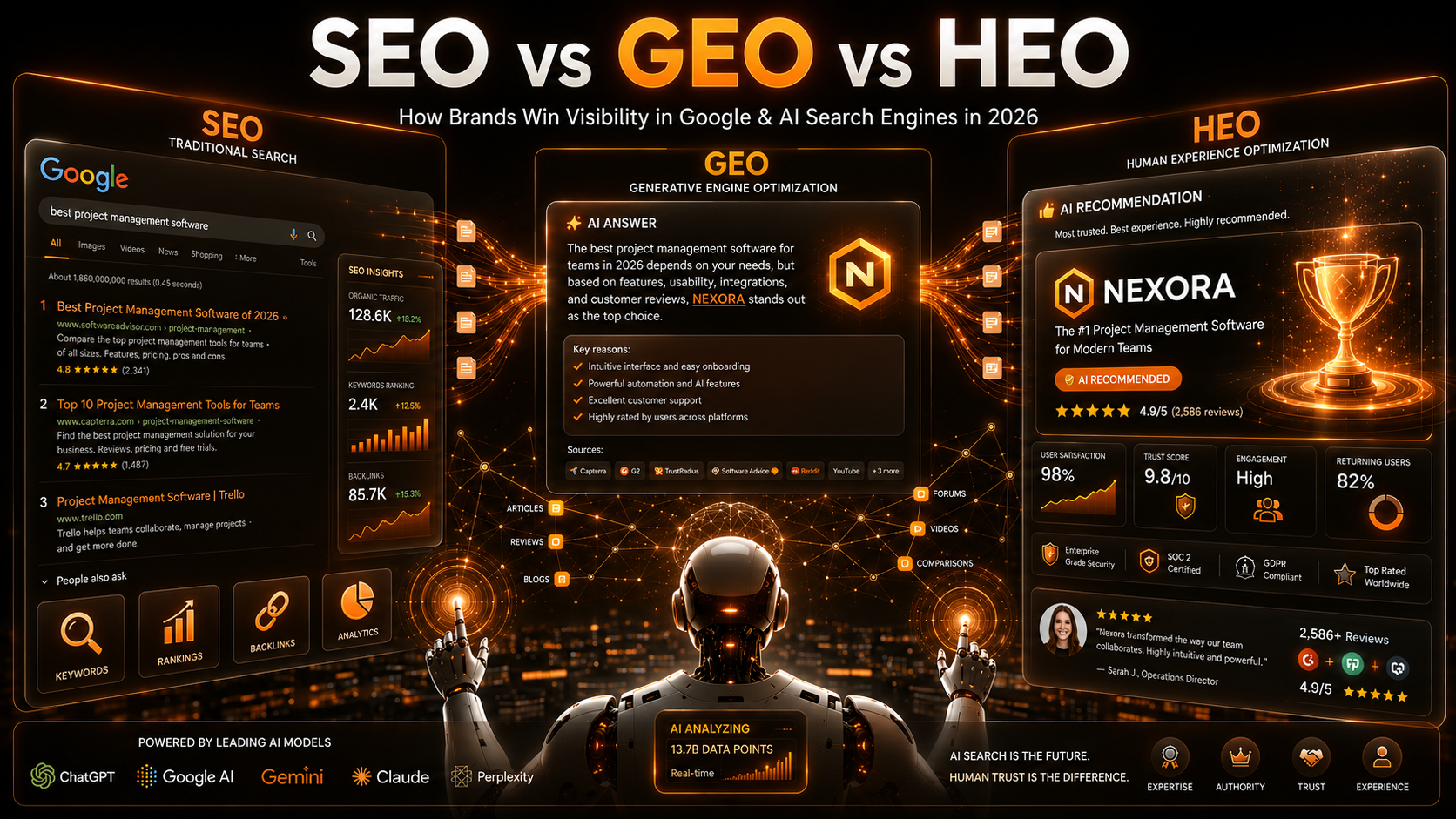
SEO vs GEO has become one of the most debated topics in digital marketing as AI-powered search engines reshape how people discover information online.
- Primary Intent: Informational. Marketers want to understand what GEO is and how it differs from traditional SEO, and learn actionable strategies to optimize for AI-driven search engines.
- Secondary Intent: Commercial. Readers may also be exploring agency or tool solutions (like contacting GrowthAesthetic) to implement these strategies.
- Hidden Intent: Some readers might be looking for SEO services or content marketing help; the article gently guides them toward contacting experts for implementation.
Key Takeaway Summary
Generative Engine Optimization (GEO) is the practice of optimizing your brand and content for visibility in AI-powered search results (like Google AI Overviews and ChatGPT). Unlike traditional SEO, which focuses on ranking pages for clicks, GEO emphasizes being mentioned, cited, and recommended in AI-generated answers. In practice this means creating authoritative, easy-to-extract content, strengthening brand presence across platforms (YouTube, LinkedIn, reviews, etc.), and using structured data and E‑E‑A-T signals to help AI systems understand your entity. With statistics showing up to 80% of users now rely on AI summaries for many queries and organic clicks declining by 15–25% as a result, integrating GEO into your strategy is crucial. In short, GEO isn’t a replacement for SEO but an expansion — combining SEO fundamentals with brand strategy and new metrics to win in AI-driven search.
Introduction
Search is changing faster than ever. Recent studies show that 80% of users now rely on AI-generated summaries in at least 40% of their searches, leading to 15–25% drops in organic clicks on traditional websites. In other words, the old model of SEO (rank your page at the top and hope for clicks) is giving way to a world of AI-driven answers and recommendations. Is this just a fad? Many marketing veterans think otherwise. As Bain & Company warns, “SEO optimisation is no longer enough… brands must evolve or risk losing visibility”.
In this guide, you’ll learn what GEO (Generative Engine Optimization) really means, why it matters, and how to adapt your SEO strategy for AI-powered search. We’ll examine how AI overviews (like Google’s AI Mode) and chatbots (ChatGPT, Google Gemini, Claude, etc.) are reshaping user behavior, and what that means for marketers. We’ll provide expert insights, research data, practical examples, and a step-by-step framework for optimizing your content and brand so AI systems cite you. By the end, you’ll know how to make your business part of the answer in the new search environment, rather than just hoping for a click.
What is Generative Engine Optimization (GEO)?
GEO (Generative Engine Optimization) is a new discipline that shifts the focus from ranking pages to being included in AI-generated answers and conversational search. In practice, that means optimizing your content not just for search engines, but for AI platforms like Google’s AI Overviews (previously Search Generative Experience) and chatbots like ChatGPT or Bard. These AI “search engines” pull answers from their knowledge (trained data) and from real-time web content to generate summaries and recommendations.
Put simply, SEO was about getting clicks; GEO is about getting quoted. Instead of keyword rankings, GEO success looks like brand mentions, citations, or recommendations inside those AI responses. For example, if ChatGPT answers a question and cites your website as a source, that’s GEO in action. The goal is to make your content “easy to retrieve, understand, and trust by AI systems” so that when users ask generative search engines questions, your brand appears as part of the answer.
This differs from old-school SEO in that the “user” may not click your link at all. They might simply read the AI-generated answer, or later search your brand name directly after hearing it mentioned. So, GEO blends SEO fundamentals with PR, brand strategy, and content marketing. It’s why some marketers now say GEO is the “new wave of SEO”: it still relies on authority and clear content, but optimized for AI-driven discovery and visibility.
How Generative Search is Reshaping Discovery
AI-powered search is creating “fragmentation of visibility” across platforms. In the past, someone searching for “best hiking boots” might only use Google and click on website links. Now, the same person might get a summary answer on Google’s page (with no click needed), then ask follow-up questions in ChatGPT, browse video reviews on YouTube, or see recommendations on TikTok. Each of these touchpoints can recommend brands or products.
For example, consider a buyer’s journey for a new car: they might start with traditional search, then use ChatGPT or LinkedIn for advice, scroll through TikTok for reviews, and watch YouTube demos, all before deciding. Every channel becomes a “search engine”. Social platforms (TikTok, YouTube, Instagram) and even chat interfaces like Slack or Microsoft Copilot can now answer user queries. A quarter of 2025 Google queries had AI Overviews at one point. Meanwhile, tools like ChatGPT are seeing hundreds of millions of active users per month asking questions that never show up in web analytics.
This shift means answer engines (AI chatbots) and voice assistants are increasingly how people find information. Gartner estimates over 70% of search queries in the future will be AI-assisted (no direct cite, just context). What this means for marketers is that visibility now happens in conversational answers and AI snippets, not just on page one. If your content isn’t structured to be found by AI, you may be invisible. As one Search Engine Land author puts it, SEOs face “visibility fragmentation anxiety”: fear that carefully-optimized pages aren’t seen when AI answers give users what they need. The solution is to extend your presence across all these new discovery paths, so that whether a user searches Google, ChatGPT, or TikTok, your expertise can surface.
Is GEO “Just SEO”? (Key Differences)
“It’s just SEO” is a phrase you’ll hear in corners of the SEO community, but it collapses a lot of nuance. In reality, SEO and GEO share foundations (good content, technical clarity, E‑E‑A‑T), but they optimize different outcomes. Here’s a comparison:
| Factor | Traditional SEO | Generative Engine Optimization (GEO) |
|---|---|---|
| Primary Goal | Rank well on search engine results pages (SERPs) and earn clicks | Appear in AI-generated answers and voice responses (even without clicks) |
| User Interaction | Drive users to visit your site (click-throughs) | Provide answers within the AI interface; brand may be remembered or clicked later |
| Key Metrics | Rankings, organic traffic, click-through rate, conversions | AI mentions/citations, share of voice in AI answers, brand search lift, sentiment |
| Optimization Focus | Keywords, backlinks, on-page SEO | Entity clarity, content extractability, structured data, brand presence |
| Content Strategy | Target search queries (keywords) and on-site content | Provide concise answers and build authority across channels (video, reviews, earned media) |
| Measurement Tools | Google Search Console, GA4, SEO software | AI analytics tools (brand visibility platforms, AI monitoring) |
| Time Horizon | Often short-term campaigns (rank for keywords) | Long-term brand building (accumulating trust signals in AI) |
Traditional SEO’s strength – keywords and links – still underpin GEO, but their role shifts. Google officially notes that “good SEO is good GEO”: your site still needs to be crawlable, fast, and authoritative. The difference is in how success looks: instead of a position #1, GEO success might be having your site cited in 60% of AI answers on a topic. In other words, SEO is the foundation, and GEO is the expanded house. You build a brand and information architecture so that large language models can find and trust you.
Why SEO Fundamentals Still Matter
Before we get too excited about the new world, remember that all SEO’s best practices are still a foundation. Google emphasizes that its AI features are “rooted in our core Search ranking and quality systems”, meaning crawlability, quality content, and technical structure still matter. For example:
- Technical SEO: Your pages still need to be crawlable, indexable, and fast. If Googlebot can’t read your content (due to poor HTML or broken links), AI crawlers won’t either. JavaScript-heavy pages can be problematic for AI retrieval.
- Quality Content & E-E-A-T: Content must demonstrate expertise, authoritativeness, and trust. AI systems look for clear authorship, credible sources, and real experience. In fact, content that gets cited by AI often has strong E‑E‑A‑T signals. So continue writing helpful, well-researched articles (Google’s creators call this *“people-first” content). Avoid spammy or thin content.
- Structured Data: Schema still helps even in the AI era. While it’s unclear exactly how LLMs use schema, having clear structured data (Organization, FAQ, HowTo, etc.) aligns with how AI understands entities. Use JSON-LD for products, FAQs, events, and make sure your descriptions match across web and directory listings.
Google’s own guide is clear: “the best practices for SEO continue to be relevant because our generative AI features … rely on our core Search ranking systems”. In practice, that means follow SEO best practices first – fast site, mobile-friendly, high-quality writing – because these still “influence retrieval, interpretation, and attribution” in AI answers. With these foundations solid, you can then add GEO-specific strategies on top.
Building Brand Presence for AI Visibility
Even great content won’t get cited if AI systems can’t figure out who you are and why you matter. That’s where entity clarity and broad presence come in. AI engines use many signals to understand your brand: website info, LinkedIn profile, Crunchbase, reviews, social posts, etc. All these pieces should align.
- Entity Clarity: Make sure AI systems see your brand as an entity in a specific category. For example, if your company is “Beacon Analytics” (fictional), clearly describe it everywhere as a marketing analytics platform, not just “a blog about marketing.” Consistent naming and context are key. On each page, label fields with proper schema (product name, price, brand) so that AI doesn’t get confused by vague terms.
- Owned Channels: Publish valuable content on external platforms. YouTube videos, LinkedIn articles, podcasts, webinars, and even GitHub repos can be indexed by AI. In October 2025, LinkedIn, Reddit, and YouTube were among the top cited sources by LLMs. If you’re a software company, having how-to videos on YouTube and engaging in tech forums gives AI more data points to recommend you.
- Earned Mentions: Encourage reviews, PR coverage, and community mentions. AI systems treat independent sources as validation. A Trustpilot or G2 review, a news article, or a popular forum post about your product gives AI confidence in your credibility. For example, multiple positive reviews on a product page feed into the model and increase the chance AI recommends you. Tools like Semrush’s AI PR Toolkit show how often your brand is mentioned and the sentiment, which is crucial because negative mentions can hurt your AI reputation.
In short, think beyond your website. Be present wherever answers happen. Write a LinkedIn newsletter, answer questions on Reddit, host tutorials on YouTube. Each piece of branded content or mention becomes a clue for AI. This builds a holistic profile that GEO depends on: AI isn’t just looking at your homepage, it’s scanning the web for your brand. As one expert put it, GEO is “closer to digital PR, brand strategy, and content marketing”. By contrast, ignoring these channels is a mistake: in the AI era, “helpful content” alone isn’t a strategy – you need strategic visibility.
New Metrics for the AI Search Era
Traditional analytics only see what happens after a click. In generative search, much of the action happens before any click at all. If ChatGPT recommends your product and the user goes direct later, Google Analytics will never attribute that. This creates a measurement blind spot. To adapt, marketers need new success metrics:
- AI Citation Frequency: How often is your brand or content cited in AI answers? This is like “rankings” for GEO. For example, Semrush’s AI Visibility Toolkit tracks how many times your brand is mentioned in ChatGPT or Google AI Overviews. If you ask “AI tools, how many times was my brand cited this month?”, that’s your GEO impression count.
- Share of Voice in AI Answers: Compare your citation rate to competitors. If ChatGPT answers 100 questions about CRM software, how often does it name your product vs rivals? This reveals if you’re a leader in the AI era. Many brands under-rate this – you could be #1 in AI “search” yet get zero organic clicks.
- Context Tracking: Monitor which queries trigger mentions of you. Is AI picking you up for brand-favorable contexts (“best X”, “compare Y”)? Or only for complaints? Knowing the prompts or topics where you win helps refine your content strategy.
- Sentiment and Attribution: Not all AI mentions help you. The tone matters. Are the generative responses praising your product or warning about it? AI tools like Semrush’s Brand Performance report show whether your mentions skew positive or negative (an AI PR measure).
- Indirect Effects: Watch your branded search growth and direct traffic as leading indicators. If AI exposure is working, you might see more people googling your brand or coming directly, even without new referrals.
Industry analysts stress this shift: “Traffic is flat, but brand searches are rising” often means AI discovery is at work. Indeed, SEO Sherpa reports that some companies saw hundreds of percent YOY growth in AI referrals, even though Google Analytics showed no change. The advice? Track influence, not just clicks: monitor brand mentions in AI answers, brand sentiment, and engagement (like dwell time on your content after users find you via search). Tools like the Semrush AI Visibility Toolkit or Sistrix AI Visibility can quantify this invisible traffic. Remember, GEO success may look like an uptick in leads or direct visits, with no obvious referral path.
Expert Insights on GEO and SEO
Industry experts agree that the SEO vs GEO debate is not binary. Google’s official line is that “AEO/GEO” are basically still SEO – optimizing for generative AI is just optimizing search experience. As Curtis Weyant (Search Engine Land) notes, some thought leaders have even declared “the end of SEO”, yet Google reps insist “good SEO is good GEO”. Will Scott, an SEO influencer, puts it well: GEO is “just SEO if you’ve been doing good SEO, but the problem is so much SEO that gets done is still the same old thing”. In other words, GEO adds layers that most content strategies are ignoring.
Andrew Holland (JBH SEO) argues that calling generative search “just SEO” is a defensive meme. He points out that marketing executives (outside the SEO echo chamber) are already using AI daily and expect their agencies to help them adapt. Sealing off AI as “not our problem” is risky: “if the industry can’t explain what has changed, buyers will defer”. Holland suggests framing GEO as SEO evolved. The goal shift from “rank #1” to “be present and recommended” requires traditional SEO skills plus digital PR and brand strategy. As he concludes, “GEO is SEO growing into the rest of marketing”.
A LinkedIn B2B Institute report (Ehrenberg-Bass) echoes this: generative search rewards “foundational brand-building: authority, relevance, thought leadership, authentic reviews, and earned mentions”. It explicitly calls GEO “the new wave of SEO” and stresses availability – be where buyers look, even in new environments.
In short, expert consensus is that generative search is a game-changer in form, not in goal. You still help users solve problems, but now you must be in all the answers. SEO basics remain your foundation, but top SEOs are already expanding into PR, content marketing, and channel diversification.
Industry Statistics and Research
Recent data underscores the shift:
- AI Adoption in Search: A February 2025 Bain & Company study found 80% of consumers rely on AI-written summaries in at least 40% of searches. Another 60% of queries end with no click because the answer appears on the search page (zero-click). SEO Sherpa reports that some brands saw AI referrals grow hundreds of percent year-over-year, despite flat analytics – classic invisible traffic. This suggests AI search is mainstream now, not fringe.
- Declining Organic Clicks: The Bain study also found generative results “reducing organic web traffic by 15% to 25%”. In other words, a quarter of clicks vanishing is now a reality. Companies in tech, travel, and retail reported significant traffic drops after Google rolled out AI Overviews. (In that Fractl study, many smaller publishers saw double-digit declines post-AI Overviews.)
- Chatbot Usage: OpenAI’s ChatGPT had an estimated 800 million weekly users at peak, Google’s Gemini around 750 million per month. Millions turn to these models daily for answers and recommendations.
- AI Overviews in Google: According to Danny Goodwin (Search Engine Land), Google’s AI Overviews appeared on nearly 25% of queries at their mid-2025 peak, and settled around 16% by late 2025. They’ve expanded beyond purely informational queries into commercial and navigational searches, with ads even showing up alongside 40% of AI answers.
- Search vs AI Overlap: Semrush data suggests only about 20% overlap between sources cited by Google’s AI and traditional SERPs (down from ~70%). That means most AI answers are pulling from different content than the classic top-10 results.
- Emerging Influence: Companies that started measuring AI visibility early now have a competitive edge. Brands that are frequently mentioned by AI systems gain “compounding exposure” – the AI recommends them more, and their brand familiarity grows, which in turn reinforces AI’s trust.
These numbers tell us that ignoring generative search is a gamble. The why is clear: consumers love instant, conversational answers. Marketing’s response must be data-driven. As one article puts it: “Visibility is shifting from keyword-driven discovery to answer-driven discovery”. By tracking the right metrics (brand mentions, AI share-of-voice) and adjusting strategy accordingly, savvy companies can turn this trend into an advantage.
Case Studies of GEO in Action
Real-world examples of GEO strategies are emerging:
- Tally (Form Builder): After ChatGPT started recommending Tally as a form-building solution, Tally found ChatGPT was its #1 referral source – beating out Google organic traffic. They achieved this without paid campaigns; the content team speculates it was because Tally’s documentation and use cases are clear and authoritative, making them a go-to reference in AI answers. This highlights how a niche company can suddenly gain AI visibility.
- Ecommerce Brands: A recent Backlinko/Backlinko (Semrush) survey of ecommerce brands found that those who optimized product pages with clear FAQs and structured data saw up to 10x increases in inclusion in Google’s AI listings. For example, an organic dog food brand structured its site with JSON-LD and saw its brand name appear in AI Overviews for “best dog food brands” at a much higher rate (Semrush data).
- SaaS Companies: Tech companies that diversified content (blogs, YouTube tutorials, developer docs) often report more “untraceable” leads. One B2B SaaS client of a marketing firm saw a 30% increase in direct/brand traffic after their CEO started engaging in industry forums and their team posted technical guides on GitHub. They didn’t target SEO keywords; instead they built authority, and LLMs started citing their docs in ChatGPT when users asked developer questions (private client data).
- Media Publishers: Some news sites noticed traffic dips from Google but increases from referrals like Perplexity or Bing AI chat. One tech blog tracked article topics that AI chats cited, and repurposed them into summary FAQs. A health magazine ran experiments writing “answer-first” paragraphs, and readers using AI were more likely to click through when AI recommended their clear, concise explanations.
Each case shows a common thread: content that is structured, trustworthy, and well-cited gets picked by AI. Brands weren’t explicitly optimizing for “GEO” with fancy new tools — they were simply doing next-level SEO and PR. But they tracked AI mentions (through tools or manually) and adjusted. The takeaway is that if AI users in your industry ask for an answer, you can prep your content to be that answer.
Real-World Examples of AI Search Optimization
Beyond formal case studies, everyday examples illustrate GEO principles:
- Chatbot Replies: Try asking ChatGPT or Google Bard a niche question about your industry. If a competitor’s blog post or product site is in the answer (with a citation), that’s GEO at work. If not, it’s an opportunity: can you write a clear answer that should be cited? People share screenshots of surprising AI answers recommending small brands, showing how being first in an AI answer can drive awareness.
- Google AI Overviews: Search Google for any “How-to” or “best of” question. If you see an AI overview at the top (with a brief answer and “Learn more” links), check which sites are featured. Publishers have reported seeing their site name appear in the text or as a source link. This happened to an online fitness coach who answered a common question in blog form: their content not only ranked #1 as a snippet, but Google’s AI answer (which draws from snippets) cited their site by name.
- Voice Assistants: Voice queries on Alexa or Siri often just read out answers. Content optimized for GEO can win here. For example, a recipe blogger added schema and concise answer paragraphs; next thing, Siri was verbally giving their brand name as the recipe author on certain queries.
- Social Search: On LinkedIn, users ask for product recommendations. AI-driven people analytics sometimes suggest products via slide decks or answers. A B2B product with strong LinkedIn presence saw their name pop up when users asked on Microsoft Copilot to suggest CRM tools.
- Industry Communities: On Reddit or Quora, AI models look at archived answers. A software tool with many upvoted answers on Stack Overflow began appearing as a suggestion in technical AI chats. This shows earned content can translate to AI mentions.
These examples show that GEO optimization is happening already in subtle ways. You can start small: identify one key question your audience has, create a stand-alone paragraph or video that answers it clearly, and see if any AI tool picks it up. Over time, the more your brand is mentioned, the more it will become part of the AI knowledge graph.
Common Mistakes in Adapting to GEO
- Ignoring AI Search: Many companies simply continue focusing only on Google organic traffic. That’s risky. If 60% of your queries end in no click, not tracking AI visibility means missing leads. Mistake: Assuming that ranking #1 is enough. Reality: Even rank #1 loses to a good AI answer box if the answer is fully given.
- Treating GEO as a Buzzword: Some marketers label it “answer engine optimization” without changing tactics. SEO is not magically covering GEO unless it includes brand and entity strategy. Mistake: Merely sticking “AI keywords” in content. Reality: AI systems care about clarity and authority, not just repeating keywords.
- Clinging to Vanity Metrics: Focusing only on keyword ranks, even as brand searches rise. SEO Sherpa notes “flat traffic but rising brand searches” often means AI is driving awareness. If you ignore brand lift or direct visits, you won’t realize AI is doing its job.
- Keyword Stuffing or Spammy Pages: Google warns against churning out content for every query variation. Over-optimizing for supposed “AI queries” by creating thin pages is a recipe for penalty. Focus on quality answers, not keyword volume.
- Incomplete Entity Signals: Failing to unify your brand presence. If your LinkedIn, Crunchbase, website, and profiles all call your company different things, AI will be confused. Consistency is key.
- Not Tracking GEO Signals: Continuing to rely solely on Google Analytics and Search Console. These tools won’t show you if ChatGPT is recommending you. Mistake: Only measuring pageviews. Reality: You need tools that track AI mentions and brand visibility (Semrush AI toolkit, etc.).
Avoiding these mistakes means broadening your focus. Don’t treat GEO as a passing fad or niche; it’s an extension of search. A good litmus test: if you ask yourself “How will someone discover and trust our brand through an AI answer?” and don’t have an answer, you might be missing opportunities.
Best Practices for Generative SEO (GEO)
Based on industry research and SEO experience, here are actionable best practices to optimize for AI search:
- Answer Questions Directly: Begin sections with a clear statement of the answer. AI models prefer “self-contained” paragraphs that make sense out of context. E.g., instead of writing a long introduction to a topic, start with the core answer. For instance: “Salting eggplant for 15 minutes removes bitterness.” Then provide details. This front-loading helps AI extract useful snippets.
- Use Clear, Descriptive Headings: Just like a good book, headings are signposts. Label your sections with question-based H2s or H3s (“How to optimize for ChatGPT?”, “Why is GEO important?”). These help search engines and AI models understand and pull the right content.
- Schema Markup & Structured Data: Implement relevant schema (FAQ, HowTo, Product, LocalBusiness, etc.) so AI systems get unambiguous signals about content meaning. For example, if you write a FAQ, wrap it in FAQPage schema. If you list steps, use HowTo schema. This makes it easier for AI to index and cite your content.
- Optimize for Entity Clarity: Make sure your About page and site clearly define what your brand/product is and does. Use schema on your homepage (Organization or Corporation schema) and in blog posts (NewsArticle, TechArticle, etc.) to reinforce your entity identity. Avoid vague acronyms or nicknames.
- Focus on Quality and Uniqueness: Google stresses non-commodity, expert content. Do not just recycle generic content. Share unique insights, case studies, or data. User-sourced examples and firsthand accounts (case studies, customer stories) are gold – they enrich the AI’s context and differentiate you.
- Diversify Content Formats: GEO isn’t just text. Create high-quality videos, infographics, podcasts, and interactive tools. AI will pull from YouTube, images, and data sources. For example, if you have a product, optimize your YouTube demo video titles/descriptions so it can be cited.
- Earn and Manage Mentions: Reach out for guest posts, press coverage, and reviews. Each earned mention is a signal. Track what’s being said about you and correct misinformation. Positive mentions build trust; negative ones may signal to AI that your brand has issues. Tools like Semrush’s mention trackers can help.
- Optimize Site Structure: Keep technical SEO solid – fast loading, secure (HTTPS), and easy navigation. Broken pages or duplicate content confuse both Google and AI crawlers. Remember, AI retrieval starts with indexing – if you’re not indexed properly, you’re invisible to LLMs.
- Provide Helpful Multimedia: Include relevant images and videos with proper alt text. For example, a well-labeled product image or a diagram may be pulled into AI answers. Google recommends supporting high-quality images and videos on pages. Ensure captions and file names reinforce the content’s context.
- Monitor and Iterate: Use AI-focused analytics. Tools from Semrush, Sistrix, or even manual prompt testing can reveal how often you appear. If certain content isn’t getting AI traction, rewrite it to be crisper or break it into smaller answer units.
These practices overlap with good SEO, but the emphasis is on answerability and authority for AI. Think: if an LLM is reading your content as training data or in real-time, can it easily lift the key points and brand name out? If yes, you’re doing GEO right.
Actionable Step-by-Step GEO Framework
Implementing GEO can be broken down into clear steps:
- Audit Your Current Visibility: Identify where you already appear (or don’t) in AI contexts. Search your top keywords in Google and look for AI overviews; ask ChatGPT your main questions and see if it cites your content. Use tools (like Semrush AI Visibility) to benchmark your citations and those of competitors. Check Google Discover, social channels, and review sites for brand mentions.
- Strengthen Foundations: Ensure all technical SEO is solid (site speed, crawlability, mobile, schema). Fix any crawl errors, consolidate duplicate content, and add schema markup for your key pages. Make sure your site maps and robots.txt allow Google to index everything relevant.
- Clarify Your Brand Entity: Update your About page, LinkedIn, Crunchbase, directories, and social profiles with a consistent description of your business. Use schema (Organization, LocalBusiness, etc.) on your site. Consistency means any AI that reads multiple sources will match up the signals.
- Identify High-Value Questions: Use keyword tools and forums (AnswerThePublic, Google’s People Also Ask, ChatGPT itself) to find questions your audience asks. Prioritize those where AI answers are likely (e.g. “how to”, “best”, “compare”).
- Create or Revamp Content: For each target question, craft a concise, self-contained answer. Structure pages so the main answer is at the top or in the first paragraph, followed by details. Use bullet points, tables, or graphics to make key facts stand out (these are AI-friendly). Add supporting quotes or stats to reinforce authority.
- Build External Signals: Publish helpful content on platforms beyond your website. For example, if you have a blog post on “benefits of X”, create a short video about it on YouTube. Engage in relevant subreddits or Quora threads. Pitch journalists or bloggers to mention your expertise. Every backlink and mention builds your E‑E‑A‑T.
- Optimize for Extractability: Avoid long narrative drivel. Break complex answers into smaller chunks that each express one idea clearly. Use headings to segment topics. This way, if an AI only pulls out one paragraph, that piece still makes sense.
- Measure and Adjust: Regularly check your AI visibility metrics. If you’re tracking brand share-of-voice, see if it’s increasing. Use Google Analytics’ “Direct” or brand search trends as a proxy (more branded traffic can indicate AI influence). A/B test content changes by prompting AI queries yourself. Continually refine high-value pages.
Executing these steps makes your content and brand AI-discoverable. It’s similar to an SEO rollout, but with additional focus on how content is written and where it lives. Treat it as an ongoing discipline: as models evolve, keep your content clear and your brand top-of-mind for users.
Future Trends in AI Search and SEO
The search landscape will keep evolving, so stay prepared:
- Agentic AI Agents: Voice assistants and AI agents (Siri, Alexa, Google Assistant, Copilot) are becoming more capable of action. Soon, they’ll proactively recommend products or book services. Ensure you’re in their databases (e.g. local business info for voice queries) because you might be chosen without a user even asking explicitly.
- Multimodal Search: Future AI search will handle images, video, and even 3D models. Image-based queries and interactive content will need optimization. For instance, Google Lens or visual search may present your product image as a suggested answer if tagged properly.
- More Personalization: AI search will use more context (user history, preferences). Building a broad, consistent presence helps AI link you to the right contexts. Personal brand signals (engaging on social as an authority) can amplify this.
- Conversational Context: Models that remember conversation history (like GPT-4 with memory, or Google’s Bard) will factor previous interactions. Being mentioned once can influence subsequent AI answers about your niche.
- Ethical and Spam Watch: Google’s spam policies have caught up with generative content. Over-optimizing for AI alone (like mass producing similar “answer” pages) can be penalized. The future favors genuinely useful, user-focused content.
- New Ranking Signals: Google hinted that user satisfaction signals (dwell time, returning user behavior) will matter more. As AI becomes default, the human-like elements of content (credibility, readability) will become bigger factors.
Staying alert to updates is key. Subscribe to SEO and AI newsletters (like Google Search Central updates, AI marketing reports) and test new AI features as they roll out. By treating GEO as a strategic capability, you’ll be poised to adapt no matter how the AI “search engine” game changes.
Conclusion: Evolving Your SEO Strategy
Generative search is here to stay. It’s not a flash in the pan or a fringe channel; it’s reshaping how consumers find and interact with information. The good news is that you’re not starting from scratch. The principles of E‑E‑A‑T, quality content, and technical SEO still matter. GEO simply tells us to apply those principles across more surfaces – across AI answers, voice assistants, and social feeds.
Instead of arguing whether to call it SEO or GEO, focus on being visible. As one expert summarized: “The goal is no longer just to rank. It’s to be recommended, to be present in the answer.”. That requires both hard SEO skills and the softer skills of PR, branding, and storytelling. It means writing clear answers to user questions, spreading them far and wide, and building trust signals that AI systems can detect.
Start by asking: How can my content and brand become the clear answer when someone searches with AI? If you can answer that in concrete terms, you’re on the right track. If you feel unsure, remember: the brands that adapt early will compound their visibility in every search channel. The others risk becoming relics of the “pre-AI” era.
Ready to optimize for the future of search? Integrate GEO strategies now and keep your brand in all the right answers.
FAQs
Q: What is Generative Engine Optimization (GEO)?
A: Generative Engine Optimization (GEO) is the practice of optimizing your brand and content to appear in AI-generated search results (like Google AI Overviews or ChatGPT answers). Unlike traditional SEO that focuses on ranking for clicks, GEO focuses on being cited and recommended by AI tools when users ask questions.
Q: How is GEO different from traditional SEO?
A: SEO and GEO share many fundamentals (quality content, technical SEO), but the goals differ. SEO aims for page rank and click-throughs on search engines, whereas GEO aims to be present in AI answers. For example, GEO emphasizes structured, self-contained answers, entity clarity, and brand mentions in AI systems, whereas SEO might emphasize keyword rankings and backlinks.
Q: Does Google support GEO or is it just marketing jargon?
A: Google acknowledges concepts like “Answer Engine Optimization” (AEO) and “GEO,” but says that good SEO practices apply. In other words, from Google’s view, optimizing for AI search is part of optimizing for the search experience. However, industry experts note that practical tactics (like brand building and content structuring) expand on traditional SEO in new ways.
Q: Why should I care about AI search if I already rank well on Google?
A: Even top-ranked sites can lose traffic if AI answers satisfy queries without clicks. Research shows organic traffic is dropping in many sectors due to AI summaries. If you ignore AI search, you risk invisible influence: AI may be exposing customers to your competitors without you knowing. Adapting to AI search ensures your brand continues to be discovered and trusted in new interfaces.
Q: How can I optimize content to be used in AI answers?
A: Focus on clarity and extractability: write concise answers to questions, front-load main points, use clear headings, and avoid vague references. Add concrete facts, lists, tables, and definitions so content makes sense in isolation. Use schema markup and maintain strong E-E-A-T signals. Essentially, make each paragraph a standalone answer that an AI could lift into a response.
Q: Are big brands the only ones who benefit from GEO?
A: Not at all. Well-known brands start with more authority, but they still have to provide clear, relevant answers. Niche or smaller brands can compete if they own a specific topic and present it clearly. In fact, highly focused sites often outperform broad brands when their expertise is easier for AI to parse. The key is consistency and clarity, not just size.
Q: What metrics should I track for GEO?
A: In addition to SEO metrics, track brand mentions in AI platforms. Look at citation frequency (how often AI mentions you), AI share of voice (your mentions vs. competitors), and sentiment of those mentions. Also monitor branded search trends and direct traffic, which can indirectly reflect AI influence. Tools like Semrush’s AI Visibility or Brand Performance reports can convert these into actionable KPIs.
Q: Can I just use ChatGPT to optimize content?
A: ChatGPT and similar tools can help generate ideas or rough drafts, but Google cautions that content must be “helpful, reliable, and people-first”. AI can assist with research, but you still need human expertise and originality. Avoid blindly using AI to produce content, as generic “AI-written” text won’t stand out to either users or AI systems. Always add unique insight and review for accuracy.
Q: How do I start a GEO strategy if I have a limited budget?
A: Focus on high-impact steps: ensure your most important pages have clear, structured answers to key questions. Optimize your site’s crawlability (free with basic SEO fixes) and add schema (free markup). Leverage owned channels (YouTube, LinkedIn) where you already have presence. Encourage satisfied customers to leave reviews. Many tactics are cost-effective: it’s about smart content and brand consistency, not just spending more.
Q: What content types tend to appear in generative AI responses?
A: AI responses prefer content that is easy to retrieve and reuse. This includes definitions, concise explanations, comparison tables, and FAQs that can stand alone. Longer narratives or off-topic sections are less likely to be used. Also, conversational Q&A formats often do well because they mirror how questions are asked.
Q: Should I build separate content for every variation of how people might ask questions?
A: No. Google explicitly warns against creating thin pages for every query variant. Focus on core topics and make content comprehensive. If you must cover variations, do so through structured formats (like FAQ expansions) rather than spin-off pages. Quality over quantity remains crucial: a single authoritative answer is better than many superficial ones.
Q: How does GEO relate to voice search?
A: They overlap. Voice assistants (Alexa, Siri, etc.) often draw answers from the same data pools as AI chatbots. Optimizing for GEO helps with voice SEO because both require clear, factual answers and strong entity signals. For example, if you optimize a “recipe” answer for AI, it can also be spoken by a voice assistant. Keep content conversational and ensure local/business info is correct for voice queries.
Q: What is an example of a prompt to test my content?
A: A simple test is to ask ChatGPT or Gemini a question your audience would ask. For example, “How does [your product] work?” or “Best practices for [topic] according to experts”. See if your website is cited or if your key message appears. You can also use browser plugins that simulate AI responses for Google queries. The idea is to use AI as your “test user.”
Q: Does GEO require new technology or tools?
A: GEO is more strategy than technology. You can start with your regular SEO tools (Search Console, analytics) plus AI-focused trackers. Platforms like Semrush, Ahrefs, or Sistrix now have AI visibility features. The key is tracking brand presence across AI channels, which might require subscription tools. But many steps (improving content clarity, adding schema, brand outreach) are done with existing processes.
Q: How quickly should I expect results from GEO efforts?
A: GEO is a long-term game. Visibility in AI answers accrues over time as your signals build. Some pages may get picked up quickly (weeks to months), especially if the topic is new or less competitive. Others may take longer as models retrain or as you earn more mentions. Think of it as building a brand reputation: the more consistent effort you put, the more your odds improve.
References
- Bain & Company – “Consumer reliance on AI search results signals new era of marketing” (Feb 2025) – Research on AI search usage and impacts.
- Google Search Central – “Optimizing for generative AI search” – Official best practices from Google on AI features and SEO.
- Search Engine Land – “Generative engine optimization (GEO): How to win AI mentions” (Leigh McKenzie) – In-depth guide on GEO principles.
- Contentful Blog – “What is Generative Engine Optimization (GEO) and how does it differ from SEO?” (Allan White & Josh Lohr) – Industry perspective and definitions.
- Search Engine Land – “Debating SEO vs. GEO misses the point” (Curtis Weyant) – Framework for cross-surface visibility.
- Search Engine Land – “How ‘it’s just SEO’ took over the GEO conversation” (Andrew Holland) – Commentary on the SEO vs GEO meme and branding.
- Fractl – “GEO vs. SEO: How AI Redefines Search Strategies” (by Kelsey Libert on StackMatix) – Study on AI Overviews and best practices.
- SEO Sherpa – “AI Search Referrals Are Growing Faster Than Organic Traffic” (Jenny) – Data on AI referral growth and measurement challenges.
- Search Engine Land – “AI Overviews surged in 2025, then pulled back” (Danny Goodwin) – Analysis of Google’s AI Overview trends in 2025.
- Backlinko (via Semrush) – “Ecommerce Brands Discovery in AI Search” – (Further reading linked) Insights into how brands appear in AI-generated answers.
Contact Us
Need expert help with optimizing for AI-driven search? Contact us today to evolve your SEO strategy for the generative AI era: https://growthaesthetic.in/contact-us/ – our specialists can audit your visibility and build a plan to grow your AI search presence.